Linked Lists
Introduction to Linked Lists:
A Linked List is a linear data structure where elements, known as nodes, are stored non-contiguously. Each node contains two parts: a data part and a reference (or pointer) to the next node in the sequence. Unlike arrays, linked lists allow for efficient insertion and deletion of elements, as nodes can be easily rearranged without needing to shift other elements. This dynamic nature makes linked lists ideal for applications requiring frequent changes. However, linked lists do not support direct access to elements, necessitating traversal from the beginning to access a specific node, and they require additional memory for storing pointers.
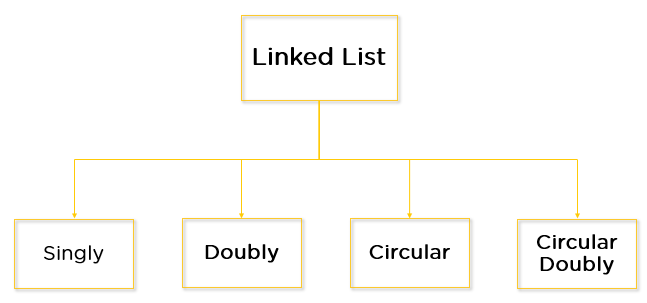
Types of Linked Lists Chart
Advantages of Linked Lists:
1. Dynamic Size: Linked lists can grow or shrink in size dynamically, allowing efficient use of memory.
2. Ease of Insertion/Deletion: Insertions and deletions are easier and more efficient compared to arrays, as there's no need to shift elements.
3. Efficient Memory Utilization: Memory is allocated as needed, reducing wastage.
Disadvantages of Linked Lists:
1. Memory Usage: Linked lists require extra memory for storing pointers, which can be an overhead.
2. No Random Access: Unlike arrays, linked lists do not allow random access to elements. Accessing an element requires traversing the list from the beginning.
3. Complexity: The implementation of linked lists can be complex and error-prone.
Types of Linked Lists:
There are several types of linked lists
1. Singly Linked List:
Definition: A singly linked list is a data structure where each node contains data and a reference (or pointer) to the next node in the sequence. It allows for efficient insertion and deletion of elements but only supports forward traversal from the head to the end. The last node’s pointer points to null, indicating the end of the list.
2. Doubly Linked List:
Definition:A doubly linked list consists of nodes where each node contains data, a reference to the next node, and a reference to the previous node. This structure allows traversal in both directions—forward and backward. The first node’s previous pointer and the last node’s next pointer are set to null, providing flexibility in navigating and modifying the list.
Singly & Doubly Linked List Diagram

3. Circular Linked List:
Singly Circular Linked List
Definition: In a circular singly linked list, the last node points back to the first node, forming a circular structure. Each node contains data and a reference to the next node, with the last node’s pointer looping back to the head. This structure allows for continuous traversal of the list, making it useful for applications requiring cyclic iteration.
Singly Circular Linked List Diagram

Doubly Circular Linked List
Definition:A circular doubly linked list combines the features of both doubly linked lists and circular linked lists. Each node contains data, a reference to the next node, and a reference to the previous node. The last node’s next pointer points to the head, and the head’s previous pointer points to the last node, enabling bidirectional traversal in a circular manner.
Doubly Circular Linked List Diagram

Applications of Linked Lists:
Linked lists are widely used in various applications, including:
1. Dynamic Memory Allocation: Linked lists allow for efficient dynamic memory allocation and deallocation.
2. Implementing Stacks and Queues: Linked lists can be used to implement stacks and queues efficiently.
3. Graphs: Linked lists are used in the adjacency list representation of graphs.
Comments
Post a Comment